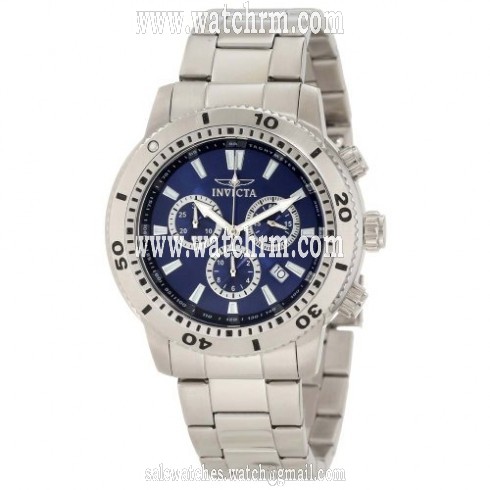
Invicta Specialty Classic Chronograph Men's Watch 10362 Details
Brand:Invicta
Series:Specialty
Model:10362
Gender:Men's
Movement:Quartz
Engine:Swiss Parts Ronda 5030.D Quartz Chronograph
Dial Color:Blue
Crystal:Flame Fusion
Hands:Silver-tone
Second Markers:Minute Markers around the outer rim
Sub Dials:Three - 60 Second, 30 Minute and 12 Hour
Luminiscence:Hands and Markers
Band Material:Stainless Steel
Band Length:9 inches
Clasp:Fold Over with Safety
Case Size:45mm
Case Thickness:15mm
Case Material:Stainless Steel
Crown:Pull / Push
Case Shape:Round
Case Back:Solid
Bezel:Uni-directional Rotating
Water Resistance:100 meters / 330 feet
Calendar:Date display between 4 and 5 o'clock position
Functions:Chronograph, Date, Hour, Minute, Second
Features:Chronograph, Stainless Steel
Style:Casual Watches
Warranty:With Manufacturer's Guarantee
Internal ID:IN10362
Watches NEWS
Diving Into History: 6 Milestone IWC Aquatimer Watches
At last year’s SIHH, IWC released a slew of new models in its revamped IWC Aquatimer collection of luxury divers’ watches (Click here to check them out). For fans of vintage watches �� and vintage IWC watches, specifically �� we highlight here five important IWC Aquatimers from the brand’s history. In 1967, IWC reacted to the growing popularity of amateur scuba diving and launched its first divers’ watch. The first Aquatimer (Ref. 812AD) was water-resistant to 200 meters and became the foundation of a successful new watch family for the watch brand from Schaffhausen.Working closely with designer Ferdinand A. Porsche, IWC began producing the Ocean 2000 sports divers’ watch (Ref. 3500) in 1982. For a time replacing the Aquatimer in the collection, It was the first series-built divers’ watch in titanium, with a tested water-resistance to 2,000 meters.In 1998, IWC reinstated the traditional Aquatimer name and launched the Aquatimer GST Automatic 2000
Seiko Astron GPS Solar Chronograph Limited Editions
In 2012, Seiko launched the Astron �C the world's first watch able to receive GPS signals and, using an onboard database, convert those signals into precisely accurate time anywhere on Earth. Powered by the Sun, the Astron is always on time, even on top of a mountain or in the middle of the ocean. Here are the two newest models, including the first-ever for women. The Astron uses the incredibly precise signals from GPS satellites to stay right on time, and when you travel, it can adjust to the time in the new location using those signals. The original Astron was a bit bulky for some wrists, but in September this year, Seiko launched its new Caliber 8X82, which allowed for a 30% reduction in the size of the watch. The upgraded movement also allows Seiko to offer a wider range of dial colors for this solar-powered watch. Finally, the movement offers a more intuitive manual time zone selection.The first Astron for women features 10 diamonds on the dial.Seiko is launching two new model
Hands-On: A Critical Comparison Of The Seiko Eichi II, Laurent Ferrier Galet Micro-Rotor, And Philip
Seiko is associated primarily with a wide range of moderately priced and reliable watches, but surprisingly, the watchmaking division operates within the diversified conglomerate Seiko Group, whose many specialties include upscale department stores, printers, semiconductors, machine tools, and of course, watches. Seiko has deep roots in timekeeping – founder Kintaro Hattori started to produce clocks in 1892 under the name Seikosha, and in 1969, almost swept the Swiss watchmaking industry off its feet with the introduction of Astron, the first commercial quartz watch. The brand has an enthusiastic collector base and an unparalleled breadth in the lineup that stretches from mainstream quartz to haute-horlogerie, something that is unique in the watchmaking industry, and a depth that is surprising given the wide spectrum of businesses the parent company is involved in.Seikosha translates to “House of Exquisite Workmanship,” and Seiko’s high-end Credor line takes thi
Tortured logic is leading me to the Platinum Daytona
I'm sure you hardened veterans have seen this a million times - a Rolex newbie trying to talk himself into doing something crazy...There is nothing rational about wanting a 116506, but here is the twisted logic I have created for myself, after going back and forth for several months now:1) The watch I spend the most $$$ on should be the one I wear the most. Therefore, a precious metal daily wearer.2) If it is going to be a daily wearer, then it has to be able to stand up to the abuse. Therefore, a sub/daytona/gmt.3) If it is going to get scratched up from daily wear, I need to be able to polish it on occasion without having to worry about wearing away the metal. Therefore, platinum. I can appreciate the patina, but then I can polish it back up and appreciate the bling every now and then. Ergo, must get Platinum Daytona. Oh yeah - and I also think it is a stunner, and I like the heft of it. And I can go back to my BLNR if I ever come to my senses.How does this sound? Am I missing anyth
Size of each wrist
I wonder which is the regular wrist limit to go from 34/36 mm to 39/41 mm in the classic Rolex��s watches ?6 inches ? 6,5 inches ? 7 inches ? more ? no limit ?


 [Rating:(5 / 5 stars)]